ABOUT
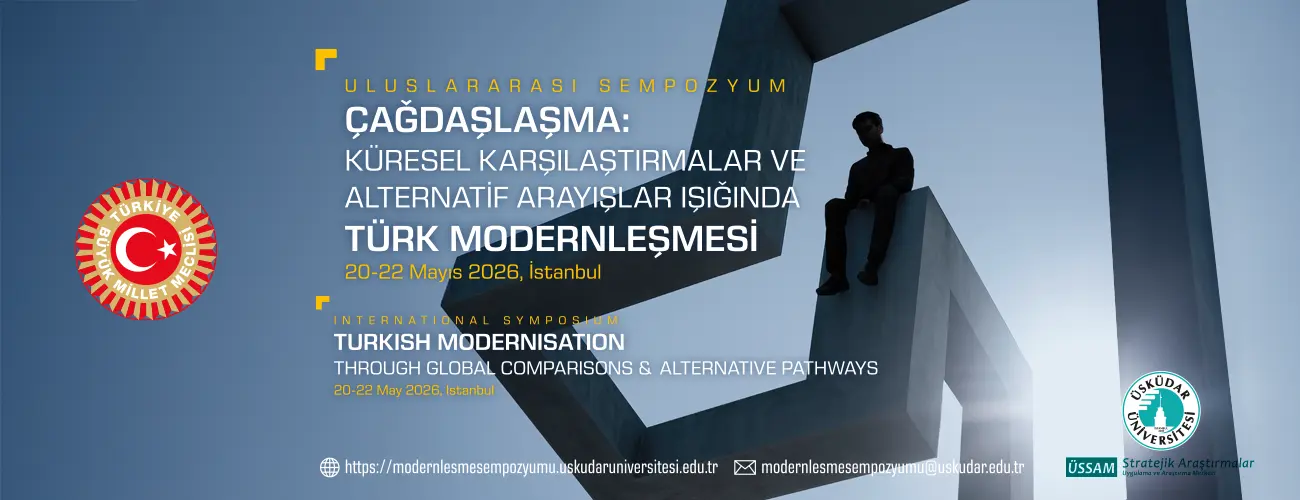
TURKISH MODERNIZATION THROUGH GLOBAL COMPARISONS AND ALTERNATIVE PATHWAYS
20-22 May 2026, Istanbul
With a history spanning two centuries, Türkiye’s modernization represents a complex, multi-layered transformation that continues to lie at the heart of contemporary intellectual and socio-political debates. Analogous to developments in other contexts, such as in Japan and Russia, this process unfolded largely in parallel with the expanding global hegemony of the West, prompting far-reaching reform initiatives in the Ottoman world in the various domains, including education, governance, law, economy, art, and religion. Over time, the earlier conception of tajdīd/ihyā, which emphasized reviving a lived “ideal model” from the past, gave way to the pursuit of an “exemplary model,” referred to as “Western civilization,” centered on political, military, and economic progress.
Modernization, which by the early twentieth century had become a central element of the intellectual and ideological expression of this pursuit, embodied in the maxim “Turkification–Islamization–Modernization,” gained renewed momentum after the declaration of the Republic, taking on new dimensions shaped by shifting social, cultural, and political orientations. In this context, marked by serious tensions over preserving identities and values coded as “traditional,” Turkish modernization encompassed not only technological and institutional transformation but also a profound change in ways of thinking and a continual negotiation over identity.
Building on this intellectual background, the international symposium titled Turkish Modernization through Global Comparisons and Alternative Pathways aims to provide an academic forum for re-examining both the historical trajectory and the contemporary manifestations of Türkiye’s modernization, while bringing comparative perspectives into a global conversation. Open to interdisciplinary engagement, the event invites contributions from the fields of history, political science, sociology, economics, law, theology, literature, art, and cultural studies.
The symposium centers on the modernization process spanning from the Ottoman era to contemporary Türkiye. It will also feature presentations that investigate various typologies of modernization or examine non-Western experiences, such as those in Russia, Japan, China, India, and across Africa, through a comparative lens. Such perspectives will make it possible to position the Turkish case within a broader global narrative of modernization and to deepen our understanding of the diverse meanings and trajectories that modernity has taken in different contexts.
To submit an abstract, visit the application page.